
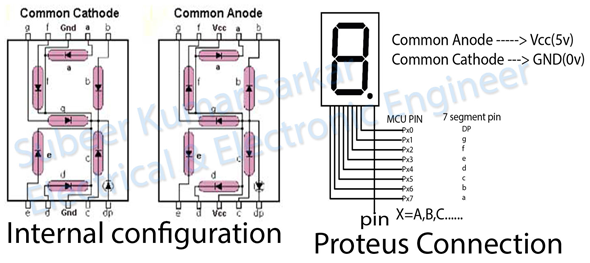
Seven Segment display are of two types
Common Cathode
Common Anode
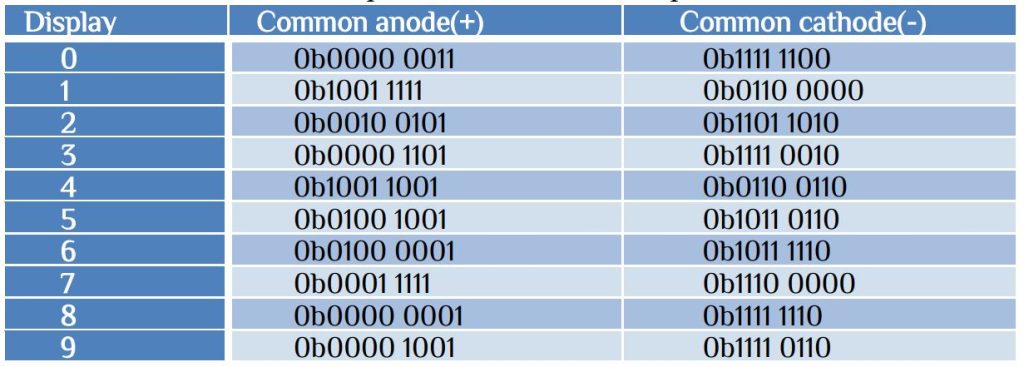
Common Cathode:- In the common cathode type 7 segment displays, the –Ve terminal of all LEDs is connected to the COM pin. A 7 segment can be lightening up when +5v is given to the respective LED segment and ground connected to common.
Common Anode:- In the common cathode type 7 segment the +5v terminal of all the LEDs is commonly connected to the common port of the 7 segment. A seven segment can be lighten up when the COM port is connected to the +5v battery supply and ground is given to respective LED segment.

Switch:- It is a conditional expression that check the resultant value compare with a set of value and give an appropriate result corresponding to that value.
Formation
switch(expression)
{
case value-1:block 1;
break;
case value-2:block 2;
break;
case value-3:block 3;
break;
—————–
default:
default –block;
break;
}
statement –x;
Let make our own seven segment display header file with the help of this switch function. Let choose a cathode LED and our user defined function should be an integer argument and integer return function. So that in user-defined function will be
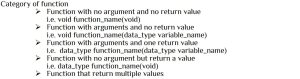
int seven_segment(int value); ——-> Function declaration
int digit=seven_segment(digit you desire); ——-> Function Call
int seven_segment(int value) ——-> Function Definition
Let separate the total user-defined function to three part. Make two new file and save as in the same folder where the main.c file saved and named it -> segment.c and segment.h. Our main goal is to separate the user-defined function and each part should include
main.c file —————–> Function call
segment.c file —————–> Function definition
segment.h file —————–> Function declaration

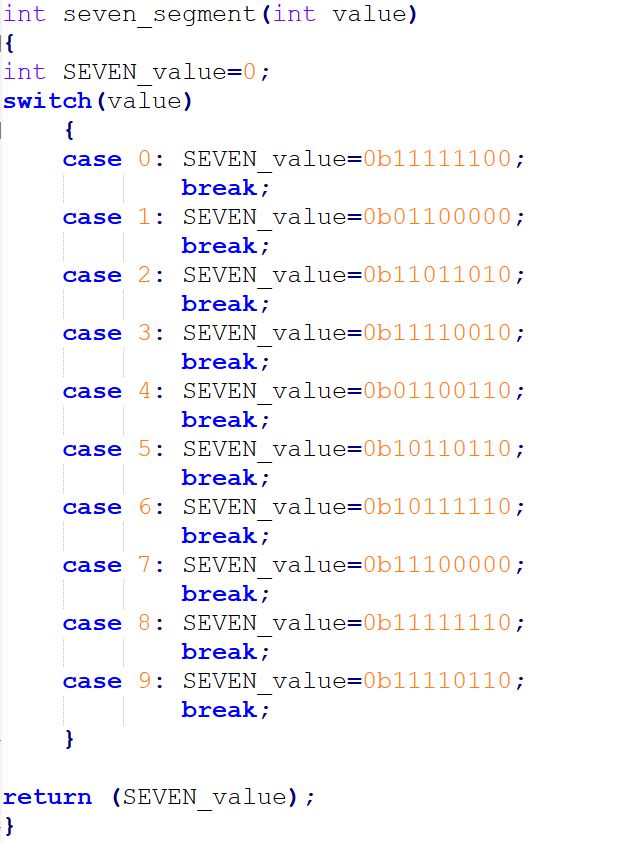
Here interesting thing that in segment.c file we include segment.h file because we store function declaration in segment.h file.

Now our main.c file is very simple. In this program we display 0-9 in 7 segment and the process repeat.
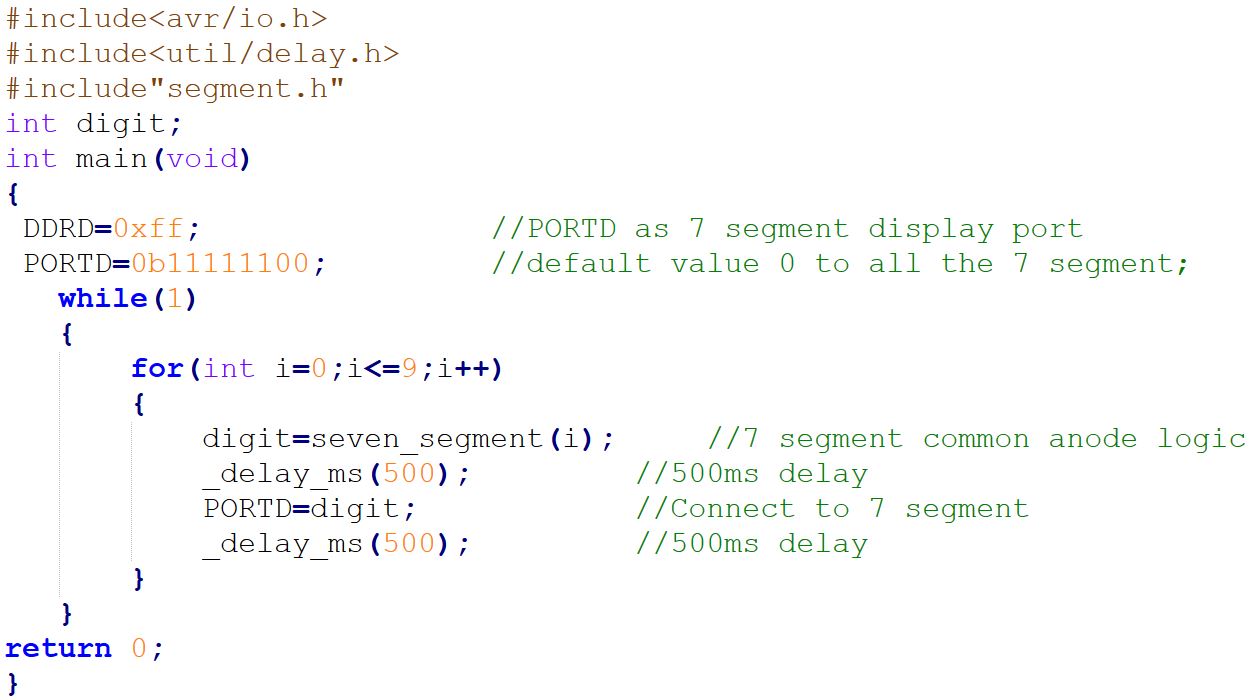
In AVR IDE platform to integrate all three file we need some change in WinAVR and Microchip Stdio. In WinAVR just change in MFile ->
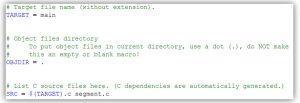

One interesting about that in WinAVR the F_CPU=8MHz and Microchip Studio F_CPU=1MHz by default.


 IoTthingHuB


 Visit Today : 59
 Total Visit : 41175